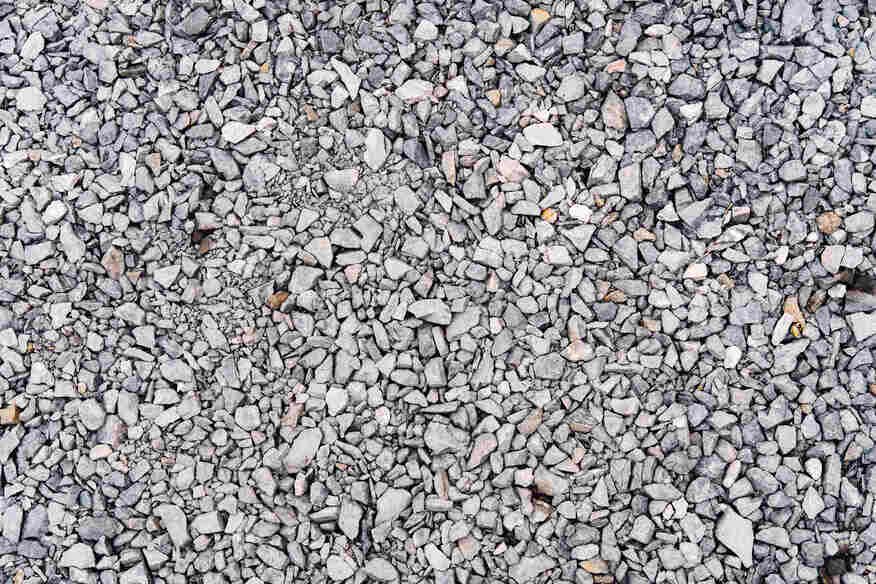
Gravel is sold two ways: by the cubic yard or by the ton. Your yard is measured in feet. That mismatch is where most people go wrong. Fortunately, you only need two quick conversions to get from a tape measure to an order you can read to the supplier.
This guide shows how much gravel you need for a driveway, path or patio base. For a quick answer, use the gravel calculator.
The basic formula
Cubic feet = length (ft) × width (ft) × depth (in ÷ 12)
Then divide by 27 to get cubic yards. To get tons, multiply cubic yards by the weight of your material. Crushed stone and gravel usually come to about 1.4 tons per cubic yard, though it ranges from roughly 1.2 to 1.5 depending on the type and how damp it is. Ask your supplier for their figure.
Example 1: a driveway, 12 ft × 50 ft, 4 inches deep
- 12 × 50 × (4 ÷ 12) = 200 cubic feet
- 200 ÷ 27 = 7.4 cubic yards
- 7.4 × 1.4 = about 10.4 tons
- Add 10% for settling and compaction: about 8.2 cubic yards or 11.4 tons
Example 2: a garden path, 3 ft × 20 ft, 3 inches deep
- 3 × 20 × (3 ÷ 12) = 15 cubic feet
- 15 ÷ 27 = 0.56 cubic yards, or about 0.8 tons
- If you’re buying bags of 0.5 cubic feet each, that’s about 30 bags.
How deep should the gravel be?
It depends on the job and the soil under it. As a rough guide, paths often get 2 to 3 inches. A patio base is often 4 to 6 inches. Driveways commonly use 4 to 6 inches or more, placed in layers and compacted. Soft or wet ground usually needs a deeper base. Local advice beats a general rule here.
Why you need extra
Gravel settles when it’s compacted, and the ground underneath is never perfectly flat. Adding 10% to 15% is common. It’s much cheaper to order a bit extra than to pay for a second delivery.
Which type of gravel?
- Crushed stone has sharp edges that lock together, so it’s popular for driveways and bases.
- Pea gravel is round and smooth, so it feels nice underfoot but shifts easily. It’s better for paths and play areas than for driveways.
- Fine road base or screenings compacts into a firm surface and is often used under pavers.
Bags or bulk delivery?
Bags suit small jobs like a path or a few planters. For anything over about a cubic yard, bulk delivery is usually cheaper, and the truck will dump it where you tell it. Check that the truck can reach your yard, and put a tarp down if you don’t want a pile on the lawn.
Common mistakes
- Using inches for the depth without converting to feet.
- Ordering exact volume and then running short after compaction.
- Mixing up cubic yards and tons.
- Skipping a proper base on soft ground.
Frequently asked questions
Do I need landscape fabric under gravel?
On soft or weedy ground, fabric helps keep the gravel from sinking into the soil and slows weed growth. On firm, well-drained ground it’s less important. Follow your supplier’s advice.
How many tons are in a cubic yard of gravel?
Usually about 1.2 to 1.5 tons, depending on the stone and how wet it is. Using 1.4 is a sensible average if your supplier doesn’t give a figure.
Is pea gravel good for a driveway?
Not usually. The stones are round and slide against each other, so cars push them around. Crushed stone locks together better and holds up under wheels.
How do I stop gravel from spreading?
Use edging along the sides, such as steel, plastic or timber borders. A compacted base layer under the top layer also helps a lot.
Related guides
See all construction and home project guides
This guide gives general estimates for planning. Materials, local codes and site conditions vary, so confirm the details for your project with a local supplier or professional.